Muhammad Unais, Vishakha Indave.
SRTR GMC, Ambajogai, Maharashtra, India.
ADDRESS FOR CORRESPONDENCE
Muhammad Unais, SRTR GMC Ambajogai, Maharashtra, India.
Email: muhammadunais079@gmail.com | | Keywords | | Aplasia cutis congenita, Group 7 ACC, Bilateral limb ACC, Familial ACC, Frieden classification, Genetic counselling. | | | Aplasia cutis congenita (ACC) is characterized by congenital absence of skin and has a wide clinical spectrum. While scalp involvement is most common, symmetrical limb involvement without epidermolysis bullosa (EB) or other associated anomalies is classified as Group 7 in Frieden’s classification.1 Familial cases of this phenotype are particularly rare.
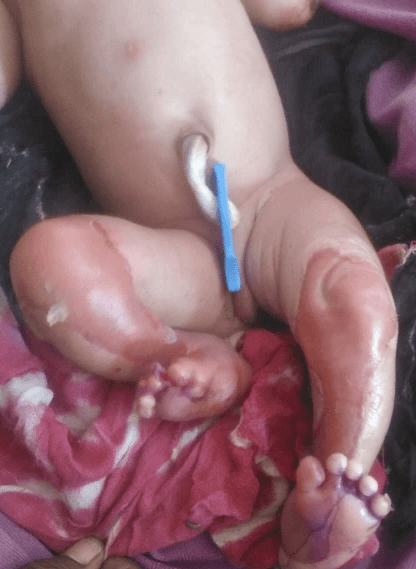
We report a term female neonate born to a 26-year-old gravida 2 mother by normal vaginal delivery. A previous neonate had died at 5 days of life with similar skin lesions (Figure 2) over both lower limbs, suggesting familial recurrence .2 There was no history of consanguinity, teratogen exposure, or maternal infection. Antenatal ultrasonography showed oligohydramnios and mild right-sided pyelectasis.
Figure 1. Term neonate with symmetrical bilateral lower limb ACC. Ulcerated, erythematous, well-demarcated areas of absent skin extending from mid-thighs to feet. Distribution consistent with Group 7 ACC as per Frieden’s classification.2
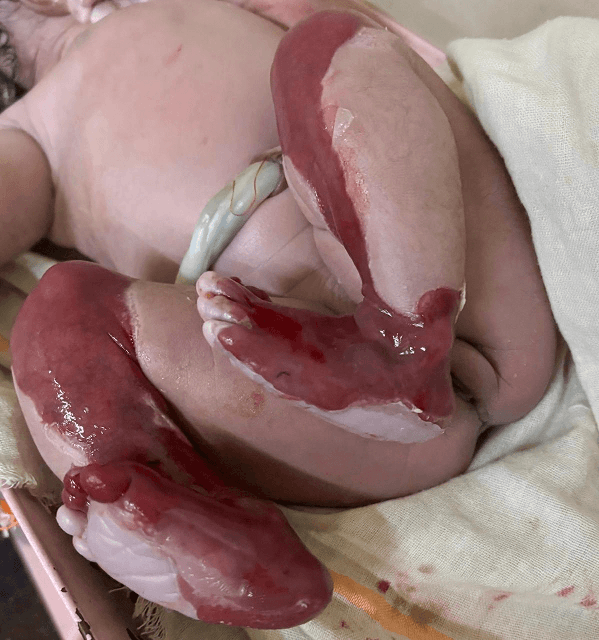
Figure 2. Newborn sibling with similar lesions in the bilateral lower limbs.
At birth, the neonate was clinically stable, with Apgar scores of 8 and 9 at 1 and 5 minutes and a birth weight of 2.9 kg. Examination revealed symmetrical, well-demarcated areas of absent skin extending from the mid-thighs to the dorsum of both feet (Figure 1). The lesions were ulcerated and erythematous with exposure of subcutaneous tissue. There were no scalp defects, mucosal abnormalities, nail hypoplasia, or other systemic abnormalities.4,5
Complete blood count and C-reactive protein were normal at birth. TORCH screening and metabolic screening were negative. Blood culture was sterile. Ultrasonography of the abdomen and cranium and echocardiography showed no associated anomalies. Skin biopsy was not performed because of parental refusal. Genetic testing, including COL7A1 and other candidate genes, was advised but could not be performed because of parental refusal.
The infant was managed conservatively with strict aseptic precautions, sterile paraffin gauze dressings, topical mupirocin, and prophylactic intravenous ampicillin and gentamicin according to the hospital protocol. Healthy granulation tissue appeared by day 5, followed by progressive epithelialization. The infant remained hemodynamically stable without evidence of secondary infection and was discharged with advice regarding wound care, follow-up, and genetic counselling.3
The symmetrical distribution, absence of blistering or mucosal involvement, absence of constriction rings, negative TORCH screening, and lack of associated anomalies supported the diagnosis of Group 7 ACC. The occurrence of similar lesions in a previous sibling raises the possibility of an inherited form, although molecular confirmation was unavailable.
Extensive ACC carries risks of fluid loss, hypothermia, secondary infection, and sepsis. Conservative wound management may be effective in isolated lesions when meticulous care and close monitoring are provided. Familial recurrence also emphasizes the importance of genetic counselling and consideration of molecular evaluation.
This case highlights that ACC need not be confined to the scalp and that symmetrical bilateral limb defects may represent a rare familial Group 7 phenotype. | | | | Compliance with Ethical Standards | | Funding None | | | | Conflict of Interest None | | |
- Frieden IJ. Aplasia Cutis Congenita: A clinical review and proposal for classification. J Am Acad Dermatol. 1986;14(4):646-660. [CrossRef] [PubMed]
- Happle R, Hoffmann R, Restano L. Bilateral ACC of the lower limbs: A new variant with possible autosomal recessive inheritance. Pediatr Dermatol. 1991;8(3):197-200.
- Leung AKC, Barankin B. ACC: Clinical presentation and management. Am J Clin Dermatol. 2010;11(6):365-372.
- Sahu S, et al. ACC: A report of two unusual cases. Indian Pediatr. 2015;52(6):529-530.
- Savaşan S, et al. Aplasia cutis congenita: Report of a case with large limb defects. Turk J Pediatr. 2014;56(3):317-320.
DOI: https://doi.org/10.7199/ped.oncall.2027.21
|
| Cite this article as: | | Unais M, Indave V. Familial Aplasia Cutis Congenita of Bilateral Lower Limbs: A Rare Variant of Group 7. Pediatr Oncall J. 2026 Sep 28. doi: 10.7199/ped.oncall.2027.21 |
|