|
Parameatal cyst in an infant
Vilma Lopes, Mariana Oliveira, Maria Adriana Rangel.
Department of Pediatrics, Centro Hospitalar Vila Nova de Gaia/Espinho Unidade 1, Vila Nova de Gaia, Portugal.
ADDRESS FOR CORRESPONDENCE
Vilma Neto Santos Lopes, Department of Pediatrics, Unidade 1, Centro Hospitalar Vila Nova de Gaia/ Espinho R. Conceição Fernandes, s/n, 4434-502 Vila Nova de Gaia, Portugal.
Email: vilmanetolopes5@gmail.com
Parameatal cyst, Urethral meatus, Infant
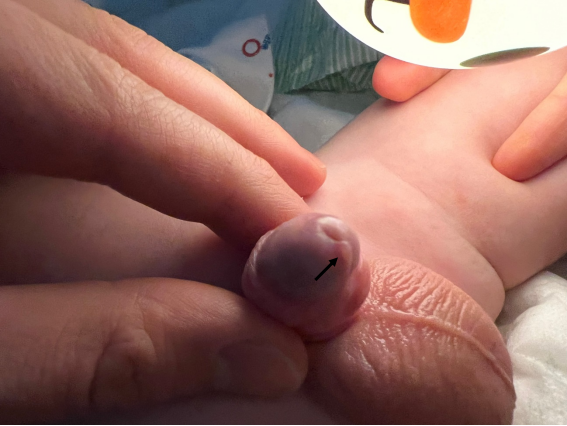
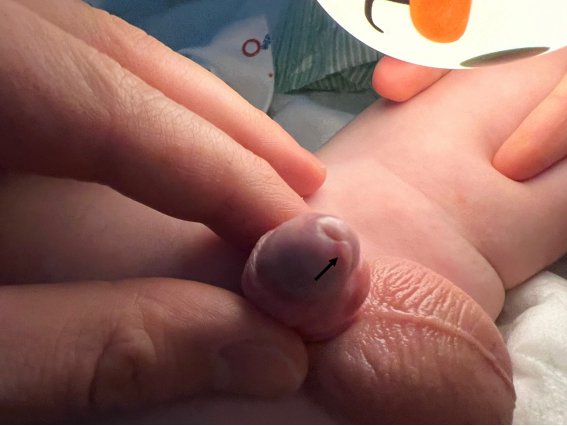
A 2-months old male infant presented in the pediatric outpatient clinic with complaints of a cystic bulge on the glans penis observed a few days earlier. There were no other symptoms, such as perception of discomfort, stream distortion, urinary flow disturbance or urinary tract infections. Trauma was denied. The patient was previously healthy and family history was unremarkable. Physical examination showed a well-defined, nontender oval cyst adjacent to the meatal opening, as shown in the image (Figure 1). The patient was seen by a Pediatric Nephrology specialist that recommended a wait-and-see approach. The patient is currently 9-month old and remains asymptomatic. Variations in size have been documented but without dimensional increase.
Figure 1. Parameatal uretheral cyst.
|
Figure 1. Parameatal uretheral cyst.
|
What is the diagnosis?
Parameatal cyst is a rare condition, with only near 50 cases described in the literature. It is a benign clinical entity that typically manifests at birth or in early childhood.1 They commonly appear on the ventral or lateral margin of the urethral meatus, usually measuring less than 1 cm and without urinary disturbances.2,3 The diagnosis is based on clinical appearance.4 The etiology and pathogenesis of these cysts remains undetermined.5 There are no known comorbidities or syndromes associated with this condition.6 Management of parameatal cysts should be conservative in asymptomatic cases. However, close observation is crucial as the cysts may increase in size and/or lead to urinary flow disturbance, dysuria, urinary retention, as well as cosmetic complaints. In such cases, a comprehensive evaluation of the urinary tract is necessary to assess for obstructive phenomena and surgical excision should be considered.4,6,7
The authors aim to raise awareness for this rare benign finding that can present a diagnostic challenge for pediatricians. |
| |
| Compliance with ethical standards |
|
Funding: None
|
|
|
Conflict of Interest: None
|
|
- S L, Ankur A. Parameatal cyst: a presentation of rare case and review of literature. J Clin Diagn Res. 2013;7(8):1757-8. [CrossRef] [PubMed] [PMC free article]
- Kaselas C, Spyridakis I, Patoulias D, Tsioulas P, Patoulias I. Parameatal Urethral Cyst in a Newborn-A Case Report and Review of the Literature. J Clin Diagn Res. 2016;10(1):SD01-2. [CrossRef] [PubMed] [PMC free article]
- Tirtayasa PMW, Samuel AG, Lisnawati, Retnowulan A. Parameatal glans cyst: A case report. Urol Case Rep. 2021;39:101802. [CrossRef] [PubMed] [PMC free article]
- Shaw SC, Vinod MS, Devgan A. Parameatal urethral cyst. Med J Armed Forces India. 2018;74(1):76-7. [CrossRef] [PubMed] [PMC free article]
- Rathod S, Neema S. Parameatal Urethral Cyst. Indian Pediatr. 2022;59(10):819. [CrossRef] [PubMed]
- Christensen CA, Mugarab-Samedi V. Management of large congenital parameatal cyst: Observation or intervention? (Case Report). Int J Surg Case Rep. 2020;69:58-60. [CrossRef] [PubMed] [PMC free article]
- Song SH, Kim DS. Neonate with a parameatal urethral cyst. AME Case Rep. 2019;3:16. [CrossRef] [PubMed] [PMC free article]
|
|
DOI: https://doi.org/10.7199/ped.oncall.2026.43 |
| |
Cite this article as:
Lopes V, Oliveira M, Rangel M A. Parameatal cyst in an infant. Pediatr Oncall J. 2026;23: 46. doi: 10.7199/ped.oncall.2026.43
|