|
Isolated cutis marmorata telangiectatica congenita
Joana Victor Lage, Rita Ribeiro Martins, Beatriz Henriques, André Salvada, Teresa Ferreira.
Department of Child and Youth, Hospital Professor Doutor Fernando Fonseca, Lisbon, Portugal.
ADDRESS FOR CORRESPONDENCE
Joana Victor Lage, Avenida do Rio de Janeiro 29, 1º direito, 1700-331, Lisboa.
Email: jvclage@gmail.com
Cutis marmorata telangiectatica congenita, CMTC, Vascular malformation, Newborn
A 24-day-old female newborn presented to the pediatric emergency department due to erythematous-violaceous cutaneous lesions in both inferior limbs that did not resolve with local warming. The patient was born full-term at 40 weeks and 4 days, with an APGAR score of 10 at both 1st and 5th minutes and a birth weight of 3145 grams. The patient’s parents were unrelated and there were no significant prenatal ou perinatal complications.
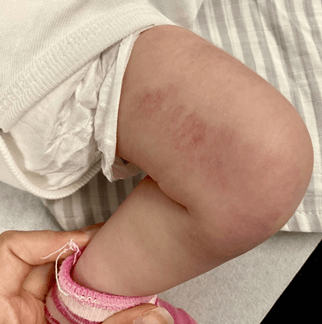
On physical examination, the infant was hemodynamically stable and well-appearing. The distinct net-like vascular pattern was observed solely on the inferior limbs. The remaining systemic examination was unremarkable. Laboratory investigation, including coagulation profile and platelet count were within normal range. Imaging via transfontanellar ultrasound and ophthalmologic evaluation showed no abnormalities. She maintained regular pediatric follow-up and over the first two years, the cutaneous lesions gradually began to fade.
Figure 1. Erythematous-violaceous net-like vascular lesions on the right inferior limb.

Figure 2. Erythematous-violaceous net-like vascular lesions on the left inferior limb.
|
Figure 1. Erythematous-violaceous net-like vascular lesions on the right inferior limb.

|
What is the diagnosis?
Cutis marmorata telangiectatica congenita (CMTC) is a rare, sporadic congenital vascular disorder of unknown etiology characterized by persistent erythematous-to-violaceous, reticulated, net-like or marbled skin lesions and occasionally ulcers.1 CMTC is usually present at birth however, there are some cases reported in the literature of delayed onset, with skin changes developing after three months. The lesions can be either localized or generalized, with the localized variant more prevalent and affecting approximately 60% of children. The most commonly affected areas are the lower limbs, although it can also occur on other regions, such as upper limbs, torso and, less frequently, on the face and scalp.2
CMTC remains primarily a clinical diagnosis. Kienast et al. proposed diagnostic criteria that require three major and two minor criteria. The major criteria include congenital marmorated erythema, absence of venectasia by one year of age and lack of response to local warming. Minor criteria include fading of erythema within two years, telangiectasia in the affected area, port-wine stains outside the CMTC area, ulcerations and cutaneous atrophy. However, these criteria have not been validated and histopathological findings in skin biopsies are often nonspecific and inconsistent.3,4
Although CMTC is often regarded as a benign condition, it can be associated with other anomalies such as limb asymmetry, skeletal anomalies, central nervous system involvement and congenital glaucoma. Individuals with isolated CMTC have no other syndromic features. When suspected, it is essential to conduct a thorough evaluation for associated anomalies, ideally involving a multidisciplinary team that includes a pediatrician, dermatologist, ophthalmologist and eventually an orthopedic surgeon.5
CMTC usually does not require any treatment. Typically, the reticular vascular skin pattern improves during the first two years, although complete resolution is rare. Various treatments have been reported including vasodilators, aspirin, pentoxifylline and psoralen plus ultraviolet-A radiation (PUVA), but their efficacy has shown considerable variability. Prognosis is generally good with the majority of patients experiencing improvement of skin lesions.6 |
| |
| Compliance with ethical standards |
|
Funding: None
|
|
|
Conflict of Interest: None
|
|
- Matic A, Prcic S, Matic M, Filipovic GV, Ristivojevic A. Cutis marmorata telangiectatica congenita in a preterm newborn - case report and literature review. Iran Red Crescent Med J. 2012;14(9): 578-583.
- González JB, Martín MMS, Casaño AV. Cutis marmorata telangiectática congenita. Review of 33 cases. An Pediatr. 2008;69(6):557-64. [CrossRef] [PubMed]
- Bui TNPT, Corap A, Bygum A. Cutis marmorata telangiectatica congenita: a literature review. Orphanet J Rare Dis. 2019;14:283. [CrossRef] [PubMed] [PMC free article]
- Kienast AK, Hoeger PH. Cutis marmorata telangiectatica congenita: a prospective study of 27 cases and review of the literature with proposal of diagnostic criteria. Clin Exp Dermatol. 2009;34(3):319-23. [CrossRef] [PubMed]
- Moreno-Alfonso JC, Caballero AM, Martínez AP. Infrequent associations of cutis marmorata telangiectatica congenita: a two-case report. Cir Pediatr. 2024;37(1):33-36. [CrossRef] [PubMed]
- Maio C, Pomero G, Delogu A, Briatore E, Bertero M, Gancia P. Cutis marmorata telangiectatica congenita in a preterm female newborn: case report and review of the literatrure. Ped Med Chir. 2014;36:161-166. [CrossRef] [PubMed]
|
|
DOI: https://doi.org/10.7199/ped.oncall.2026.21 |
| |
Cite this article as:
Lage J V, Martins R R, Henriques B, Salvada A, Ferreira T. Isolated cutis marmorata telangiectatica congenita. Pediatr Oncall J. 2026;23. doi: 10.7199/ped.oncall.2026.21
|