|
Post-vomiting Purpura in children rare phenomenon but do occur
Muneer Hassan Albagshi.
Department of Pediatrics, AlMana general Hospital, Al Ahsa, Saudi Arabia.
ADDRESS FOR CORRESPONDENCE
Dr Muneer Hassan Albagshi, Prince Mishal Road, Hofuf, 31982, Saudi Arabia.
Email: mbagshi@gmail.com
Purpura, Petechial rash, Vomiting, Children
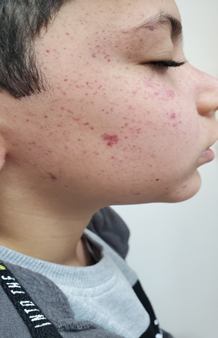
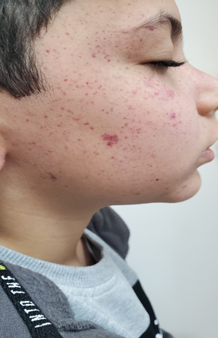
Eight-year-old male child who presented with red facial rash after a single episode of forceful vomiting following paracetamol syrup ingestion for headache. The patient denied experiencing pruritus or pain of the lesions. There is no preceding history of fever or upper respiratory tract infection. There are no similar lesions elsewhere in the body. The examination was unremarkable except for multiple non palpable purpura and few petechial rash (Figure 1). He had similar history of facial rash after cough. The father had similar episode in the past. The child had been seen by the pediatrician on the same day for common cold. Complete blood count done and showed hemoglobin of 126 g/L, platelets of 312 x 109/L and white blood count of 5.87 x 10⁹/L.
Figure 1. Petechial and purpuric lesions on face of the child which sparing the neck.
|
Figure 1. Petechial and purpuric lesions on face of the child which sparing the neck.
|
What is the most appropriate diagnosis?
We diagnosed the child to have post-vomiting purpura.
This condition occurs after forceful vomiting and the petechial rash is isolated to face area with normal skin the absence of lymphadenopathy or abdominal organopathy. Complete blood count in showing normal platelet count, hemoglobin and white blood count including differential count.
This phenomenon occurs due to an increase in intravascular pressure due to sudden increase of the thoracic pressure following; vomiting, Valsalva, coughing, crying, delivery and endoscopy have been described to result in this phenomenon.1 It affects the blood vessels of the loose tissues of the face and neck. The manifestation is worrying for the patient and family and can misleading for the physician to make him extend the investigations for this phenomenon unnecessarily. The location of the lesions in the face and part of the neck make the diagnosis easy if the index of suspicion is high. The differential diagnoses of facial purpura in children include IgA vasculitis, systemic lupus erythematosus, thrombocytopenic purpura, acute hemorrhagic edema, purpura fulminans, drug eruption, amyloidosis and trauma. Post-vomiting purpura is self-limited condition and typically fades within few days without intervention.2
Physicians should be aware of this diagnosis after taking their patient history, physical examination and location of the lesions. Basic laboratory studies can aid in diagnosis of this phenomenon by ruling out other etiologies that must also be considered in the acute setting without the need for further investigations. The parents should be reassured about the benign nature of the condition which does not need therapy. |
| |
| Compliance with ethical standards |
|
Funding: None
|
|
|
Conflict of Interest: None
|
|
- Kaliyadan, F., & Kuruvilla, J. P. (2016). Post-vomiting purpura. Indian dermatology online journal, 7(5), 456-457. https://doi.org/10.4103/2229-5178.190510. [CrossRef]
- Ono, R., Takahashi, H., & Fukushima, K. (2021). Emesis-induced facial purpura as a mask phenomenon. BMJ case reports, 14(2), e241456. https://doi.org/10.1136/bcr-2020-241456. [CrossRef]
|
|
DOI: https://doi.org/10.7199/ped.oncall.2025.35 |
| |
Cite this article as:
Albagshi M H. Post-vomiting Purpura in children rare phenomenon but do occur. Pediatr Oncall J. 2025;22: 164. doi: 10.7199/ped.oncall.2025.35
|