|
Funny gait in a child with rheumatic heart disease
Marta Figueiredo1, Marcela Pires1, Rita Belo Morais1, Inês Mendes2, José Carlos Ferreira3.
1Pediatrics Department, Hospital de São Francisco Xavier, Unidade Local de Saúde de Lisboa Ocidental, Lisbon, Portugal,
2Pediatric Cardiology Department, Hospital de Santa Cruz, Unidade Local de Saúde de Lisboa Ocidental, Lisbon, Portugal,
3Neurology Department, Hospital de São Francisco Xavier, Unidade Local de Saúde de Lisboa Ocidental, Lisbon, Portugal.
ADDRESS FOR CORRESPONDENCE
Marta Santos Figueiredo, Estrada Forte do Alto Duque, 1449-005, Lisbon, Portugal.
Email: msfigueiredo@chlo.min-saude.pt
chorea, movement disorder, streptococcus pyogenes, rheumatic fever, non-suppurative complication
A 14-year-old female from Cape Verde, presented to the emergency room with a 9-day history of progressive abnormal speech and gait. She had no fever, headache, odynophagia, arthralgia, visual, muscle strength, or sensitivity alterations. Diagnosed with rheumatic heart disease at the age of 7, she was on warfarin after mitral valve replacement, and mensal intramuscular benzylpenicillin, though with irregular adherence. Given the “de novo” neurological alterations and poor adherence to anticoagulant therapy, an ischemic stroke was initially suspected.
On admission, she was afebrile, with normal vital signs, and no skin or oropharyngeal alterations. She had a grade III/VI systolic-ejection murmur at the left sternal border. Neurologically, she was conscious, oriented, and cooperative, but revealed impaired verbal fluency, facial grimacing, motor impersistence, and choreiform appendicular and axial movements, including of the face and tongue, with bilateral milkmaid’s sign (Figure 1).
Figure 1. Milkmaids' sign: when asked to grip the examiner’s fingers she had an irregular pattern of flexion (A) and extension (B) and was unable to sustain consistent grip pressure.
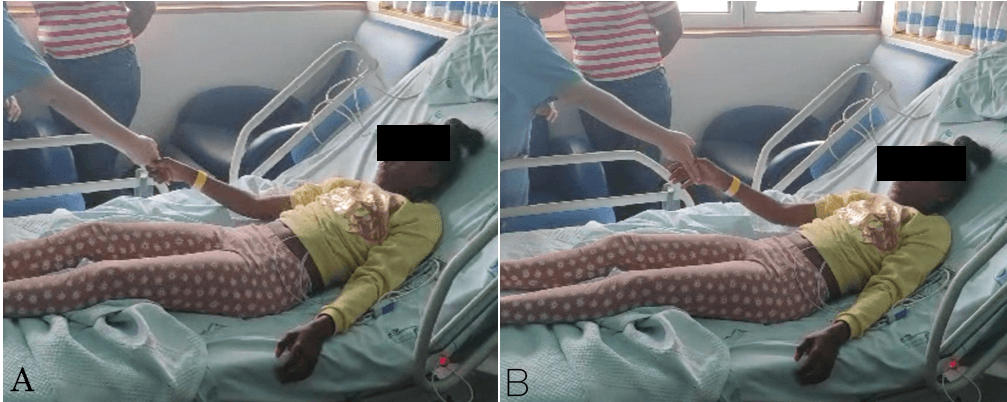
Blood work revealed an erythrocyte sedimentation rate of 60 mm/h. C-reactive protein, oropharyngeal group A Streptococcus (GAS) rapid antigen test and Anti-streptolysin O (ASO) titer were negative. Cranial CT and angio-CT scans were unremarkable. Echocardiography showed mild mitral, aortic, and tricuspid regurgitation, with normal ventricular function and no vegetations, consistent with previous evaluations.
Stroke was ruled out and Sydenham chorea (SC) was assumed. She started prednisolone (2 mg/kg/day) for 2 weeks, tappered over 3 weeks. Monthly intramuscular benzathine penicillin was reinitiated. Symptoms resolved completely within one month.
|
What is the diagnosis?
Chorea is a movement disorder defined by unpredictable and involuntary movements of the extremities and trunk.1,2 Other manifestations include dysarthria, emotional lability and motor impersistence, frequently evidenced by the darting tongue and milkmaid’s sign1,2, as in our patient.
SC is a delayed neurological manifestation of a GAS infection and a major criteria of rheumatic fever (RF) diagnosis, occurring in 10-30% of patients.1,3 Its etiology is not fully understood, but appears to involve an auto-immune response against basal ganglia.3 It’s the leading cause of acquired chorea in children, most prevalent between ages of 5-18.2,4
SC diagnosis is based on acute onset of chorea with no alternative etiology. It is supported by evidence of recent streptococcal infection, either by a positive throat culture, ASO or anti-DNAse antibodies or by the presence of carditis.1,2 However, unlike other RF manifestations, SC has a 1-3 month latency after infection, so many patients lack laboratory evidence of streptococcal infection1, as in this case.
Most cases resolve in 2-6 months, but 20% follow a persistent course. Relapses may occur, often due to new streptococcal infections, even if asymptomatic.1,2 In this case, relapse likely resulted from a re-infection due to poor antibiotic prophylaxis adherence.
SC management remains controversial. Treatment is usually supportive, but depending on symptoms some patients require dopaminergic antagonists, antiepileptics or immunomodulators.4 Some studies suggest systemic corticosteroids may accelerate recovery3,4, which was our approach.
SC is infrequent in developed countries but should be considered, particularly in children with previous RF. Prevention relies on prompt recognition and treatment of streptococcal pharyngitis, and avoidance of recurrent infection by using long-term antibiotic prophylaxis with intramuscular benzathine penicillin G.3,4 |