Teresa Cachada Baptista, Bárbara Costa Correia, Andreia Meireles, Juliana Oliveira, Catarina Carvalho.
Pediatric and Neonatology Department, Unidade Local de Saúde do Tâmega e Sousa, Penafiel, Porto, Portugal.
ADDRESS FOR CORRESPONDENCE
Teresa Cachada Baptista, Travessa de Vilar, nº 77, 4595-085 Eiriz, Paços de Ferreira, Porto, Portugal.
Email: atscbaptista@gmail.com | | Keywords | Neonatal testicular torsion, Late prenatal, Scrotal soppler ultrassound.
| | | Neonatal testicular torsion (NTT) is a rare perinatal condition, with an incidence of approximately 6 per 100,000 live births, accounting for 10-12% of pediatric testicular torsion cases.1,2 It results from twisting of the spermatic cord, leading to venous obstruction, reduced arterial flow, and ischemia, which may cause necrosis if not resolved within 4-6 hours.1,2,4
Testicular torsion can be categorized according to the location and extention of spermatic cord rotation. Intravaginal torsion refers to rotation occurring within the tunica vaginalis, involving the testis and spermatic cord. Conversely, in extravaginal torsion, the rotation occurs external to the tunica vaginalis, affecting the entire spermatic cord as well as the testis and epididymis.1,3,4
NTT is extravaginal in 85–90% of cases, typically occurring prenatally or intrapartum.1,3,4 Risk factors include breech presentation, prolonged labour, and large birth weight.1,3 Prenatal NTT is often asymptomatic, presenting as a firm, discoloured scrotal mass; postnatal cases may show swelling, erythema, or tenderness.1,5
Differential diagnoses include birth trauma, orchiepididymitis, hemorrhage, hydrocele, hernia, appendage torsion, neoplasm, and cellulitis.1,4 Male newborn (NB), resulting from an uneventful, monitored pregnancy. Maternal serologies and viral markers were negative, and prenatal ultrasounds were normal. Group B Streptococcus test was negative. Spontaneous membrane rupture occurred 6 hours before delivery, with clear amniotic fluid. The infant was born at 40 weeks and 6 days gestation, via eutocic delivery, with Apgar scores of 9/10/10, requiring no resuscitation. Birth measurements were appropriate for gestational age: weight 3400 g (P25), length 50 cm (P20), and head circumference 36 cm (P65), according to WHO growth charts.
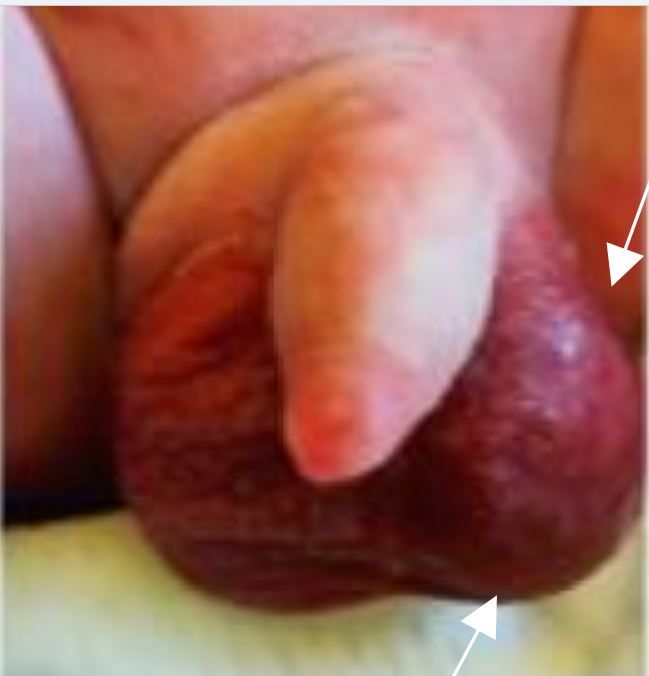
During the first assessment by the paediatrician on day 1 of life, the newborn showed, in the external genital region, oedema and dark red discoloration of the left testicle were detected (Figure 1). Palpation revealed a hard, immobile, and painless swelling. Since birth, the newborn had not exhibited periods of irritability, intense crying, or feeding refusal. Given these findings, a scrotal Doppler ultrasound was performed, showing preserved testicular blood flow on the right but absence of flow in the left testicle, consistent with suspected left testicular torsion. The newborn was immediately transferred to the Paediatric Surgery Department, where he underwent left orchiectomy due to testicular necrosis and orchidopexy of the right testicle.
Clinical presentation of testicular torsion varies by timing at which the torsion develops (prenatal/neonatal). In this case, a swollen, firm, painless testicle suggested late prenatal torsion. Scrotal color doppler ultrasound is the preferred diagnostic tool, typically showing testicular enlargement, a normally sized testis with heterogeneous echotexture and absent vascular flow, or a small, hyperechoic testis. Marked enlargement often indicates prolonged torsion. Nuclear scintigraphy may aid in assessing perfusion.1
Figure 1. The image shows the left testicle swollen with a purplish-red colour consistent with testicular torsion.
Management remains debated, ranging from observation to immediate or delayed contralateral orchidopexy.1 Some delay surgery due to low salvage rates, while others advocate early contralateral fixation to prevent anorchia.1 In this case, orchiectomy and contralateral orchidopexy were performed on the day of diagnosis.
This case underscores the importance of rapid evaluation and intervention to avoid testicular loss. | | | | Compliance with Ethical Standards | | Funding None | | | | Conflict of Interest None | | |
- Kylat, R. I., & Ahmed, M. N. (2022). Neonatal testicular torsion. African journal of paediatric surgery : AJPS, 19(1), 1-4. https://doi.org/10.4103/ajps.AJPS_153_20. [CrossRef] [PubMed] [PMC free article]
- B Abraham, M. B., Charles, A., Gera, P., & Srinivasjois, R. (2016). Surgically managed perinatal testicular torsion: a single centre experience. The journal of maternal-fetal & neonatal medicine : the official journal of the European Association of Perinatal Medicine, the Federation of Asia and Oceania Perinatal Societies, the International Society of Perinatal Obstetricians, 29(8), 1265-1268. https://doi.org/10.3109/14767058.2015.1044430. [CrossRef] [PubMed]
- Riaz-Ul-Haq, M., Mahdi, D. E., & Elhassan, E. U. (2012). Neonatal testicular torsion; a review article. Iranian journal of pediatrics, 22(3), 281-289.
- Mano, R., Livne, P. M., Nevo, A., Sivan, B., & Ben-Meir, D. (2013). Testicular torsion in the first year of life--characteristics and treatment outcome. Urology, 82(5), 1132-1137. https://doi.org/10.1016/j.urology.2013.07.018. [CrossRef] [PubMed]
- Bowlin, P. R., Gatti, J. M., & Murphy, J. P. (2017). Pediatric Testicular Torsion. The Surgical clinics of North America, 97(1), 161-172. https://doi.org/10.1016/j.suc.2016.08.012. [CrossRef] [PubMed]
DOI: https://doi.org/10.7199/ped.oncall.2026.57
|
| Cite this article as: | | Baptista T C, Correia B C, Meireles A, Oliveira J, Carvalho C. Silent swelling - a diagnosis to remember. Pediatr Oncall J. 2025 Sep 27. doi: 10.7199/ped.oncall.2026.57 |
|