|
Scalp Abscess in a Newborn: A Rare Condition With An Unusual Etiology
Luzia Condessa, Cristina Novais, Carlos Castaneda, Rosário Sossai, Manuel Cunha.
Pediatric Functional Unit, Hospital de Cascais - Cascais, Portugal.
ADDRESS FOR CORRESPONDENCE
Luzia Condessa, Avenida Brigadeiro Victor Novais Gonçalves, Hospital de Cascais, 2755-009, Cascais, Portugal.
Email: luziacondessa@gmail.com
scalp abscess, infection, newborn
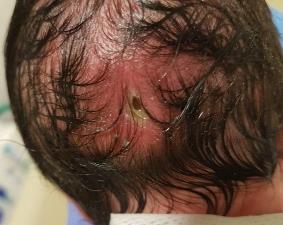
A four-day-old term female newborn was admitted to the Neonatal Unit following observation of an occipital fluctuant, edematous, and erythematous mass measuring approximately 3 cm in diameter, which was spontaneously draining a purulent and fetid exudate (Figure 1). The gestational history was unremarkable. The infant was born via forceps-assisted vaginal delivery 9 hours after rupture of membranes, with meconium-stained amniotic fluid. Apgar scores at birth were 6, 8 and 8 at 1, 5 and 10 minutes, respectively. The newborn required suctioning of secretions and positive pressure ventilation during the first minutes of life. The immediate neonatal period was uneventful. On admission day, besides the scalp lesion, the newborn appeared well and afebrile, with normal vital signs and no additional abnormal findings. Laboratory work-up revealed 17860/µL leukocytes with 12323/µL neutrophils and a C-reactive protein of 15.3 mg/dL. Blood and exudate samples were collected and empirical antibiotics initiated according to our unit’s protocol (flucloxacillin and gentamicin). Therapy was later adjusted to ampicillin, gentamicin and cefotaxime based on antibiogram results from the exudate culture, which identified Citrobacter freunddi and Enterococcus faecalis. After initiation of targeted antibiotics, the newborn showed noticeable clinical improvement, with normalization of leukocyte count and C-reactive protein levels (0.41 mg/dL). Blood culture came out negative. The infant was discharged after completing a 14-day antibiotic treatment course.
Figure 1. Scalp abscess on 4th day of life.
|
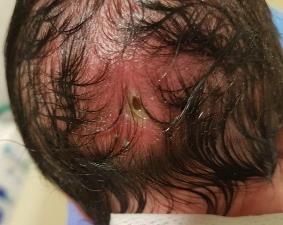
Figure 1. Scalp abscess on 4th day of life.
|
What is the diagnosis?
Neonatal scalp abscess is a rare condition, with reported incidence of 0,1-5%.1 It is frequently associated with fetal monitoring procedures, scalp contusions and instrumental deliveries.2 Hematogenous seeding may also contribute to its development.2 The etiology is often polymicrobial (aerobic and anaerobic bacteria), reflecting maternal vaginal flora.1,2 In this case, the isolated agents – Citrobacter spp. and Enterococcus faecalis - are commonly found in the gastrointestinal tract.3 Although rarely isolated in skin infections, these microorganisms have been reported in neonatal brain abscesses and meningitis.3 Scalp abscesses represent a significant risk due to potential extension to adjacent tissues, leading to complications such as intracranial infections, osteomyelitis, or sepsis.2 Prompt diagnosis and appropriate antibiotic treatment are essential to ensure a favorable clinical outcome. |
| |
| Compliance with ethical standards |
|
Funding: None
|
|
|
Conflict of Interest: None
|
|
- Weiner EJ, McIntosh MS, Joseph MM et al. Neonatal scalp abscess: is it a benign disease? J Emerg Med. 2011;40(5):e97-101 [CrossRef] [PubMed]
- Liu H, Li Z, Yang L, Yang X et al. A 9-day-old neonate with giant scalp abscess: A case report. Medicine (Baltimore). 2019; 98(48):e17830. [CrossRef] [PubMed] [PMC free article]
- Plakkal N, Soraisham A, Amin H. Citrobacter freundii Brain Abscess in a Preterm Infant: A Case Report and Literature Review. Pediatrics & Neonatology. 2013; 54(2):137-140.3 [CrossRef] [PubMed]
|
|
DOI: https://doi.org/10.7199/ped.oncall.2027.3 |
| |
Cite this article as:
Condessa L, Novais C, Castaneda C, Sossai R, Cunha M. Scalp Abscess in a Newborn: A Rare Condition With An Unusual Etiology. Pediatr Oncall J. 2025 Nov 17. doi: 10.7199/ped.oncall.2027.3
|