Anusha B N1, Suneel C Mundkur1, Karen Janice Moras1, Rochelle Anne Pereira2, Pragathi K Kunder1.
1Department of Paediatrics, Kasturba Medical College, Manipal, India,
2Department of Paediatrics, Kasturba Medical college, Manipal, India.
ADDRESS FOR CORRESPONDENCE
Suneel C Mundkur, Department of Paediatrics, Kasturba Medical College, Manipal, Udupi, Karnataka - 576104, India.
Email: Suneel_cm@hotmail.com | | Abstract | Retropharyngeal abscess (RPA) is a potentially life-threatening deep neck space infection commonly affecting young children, though it may also occur in older children following trauma or upper airway infections. Early diagnosis and prompt management are essential because of the risk of airway compromise and mediastinal spread.
We report a 12-year-old boy who presented with fever, painful left infra-auricular swelling, trismus, dysphagia, and restricted neck movements following accidental fish bone ingestion. Imaging revealed a left retropharyngeal abscess with surrounding inflammatory changes. Intraoperatively, an abscess within the left paravertebral muscle was identified and drained under general anaesthesia. Pus culture grew Streptococcus parasanguinis. | | | | Keywords | | Retropharyngeal abscess, Deep neck space infection, Streptococcus parasanguinis, Fish bone injury. | | | | Introduction | | Retropharyngeal abscesses are rare but potentially life-threatening infections that primarily affect children younger than 5 years and, occasionally, adults. They are pus-filled collections within the retropharyngeal space, located between the buccopharyngeal fascia anteriorly and alar fascia posteriorly. In younger children, antecedent upper respiratory tract infections commonly lead to abscess formation, whereas in older children and adults, trauma to the posterior pharynx may precipitate infection by inoculating the retropharyngeal space, resulting in subsequent abscess formation. | | | | Case Report | A 12-year-old boy presented with five- day history of progressively enlarging, painful swelling below the left ear associated with fever, restricted neck movements, difficulty in opening mouth and dysphagia. There was no history of respiratory distress, dental infection, skin discoloration, or weight loss. A history of accidental fish bone ingestion five days prior to the onset of symptoms was present.
The child was conscious and hemodynamically stable. Diffuse tender swelling measuring approximately 5 × 5 cm was noted over the left infra-auricular and upper cervical region extending up to the angle of the mandible. Otorhinolaryngological examination revealed posterior pharyngeal wall fullness with a mild bulge over the left buccal mucosa. No airway compromise was noted.
Laboratory investigations demonstrated leukocytosis (22.7 x 10⁹ L) with neutrophilic predominance of 94.5% and elevated inflammatory markers. C-reactive protein was markedly elevated (130.92 g/dL). Blood culture was sterile.
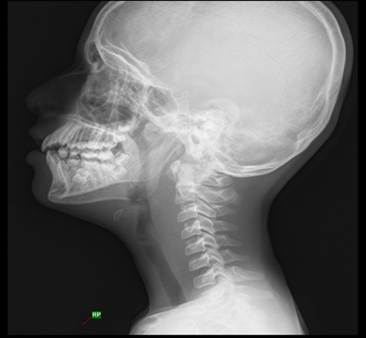
Lateral neck radiograph showed widening of the retropharyngeal soft tissue shadow. (Figure 1)
Figure 1. Increase in soft tissue thickness in the retropharyngeal space.
Contrast-enhanced computed tomography (CECT) of the neck revealed a peripherally enhancing collection measuring approximately 1.9 × 1.4 × 1.9 cm in the left retropharyngeal space, involving the longus colli muscle, with surrounding inflammatory changes and reactive cervical lymphadenopathy, suggestive of a retropharyngeal abscess.
The child was started on ceftriaxone, amikacin, and vancomycin. In view of the imaging findings, emergency incision and drainage under general anaesthesia was performed, and pus culture yielded Streptococcus parasanguinis, which was sensitive to used antibiotics. Postoperatively, the child showed significant clinical improvement, with reduced swelling, improved mouth opening, and resolution of fever. | | | | Discussion | Retropharyngeal abscess (RPA) is a potentially life-threatening deep neck space infection that predominantly affects children younger than five years due to suppuration of retropharyngeal lymph nodes following upper respiratory tract infections, tonsillitis, sinusitis, or local trauma. As these lymph nodes regress by 4-5 years of age, RPA becomes uncommon in older children and adolescents1,2 Coticchia et al. reported that RPA accounts for approximately 30–40% of paediatric deep neck infections, with nearly 75% of cases occurring in children younger than five years, making presentation in adolescence relatively uncommon.3
The clinical manifestations of RPA are often nonspecific and include fever, neck pain, dysphagia, odynophagia, torticollis, drooling, and respiratory distress.4,5 However, atypical presentations may delay diagnosis. In our patient, painful infra-auricular swelling and fever initially suggested parotid pathology or cervical lymphadenitis rather than a deep neck infection.
Craig and Schunk observed that delayed recognition of RPA may increase the risk of serious complications, including airway compromise, mediastinitis, and extension into adjacent deep neck spaces.5
A notable feature of our case was the antecedent history of fish bone ingestion. Trauma to the posterior pharyngeal wall caused by an ingested foreign body is a recognized predisposing factor for RPA in older children and adolescents.1,6 Mucosal disruption facilitates bacterial inoculation into the retropharyngeal space, resulting in localized suppuration and abscess formation.
Grisaru-Soen et al. emphasized the role of contrast-enhanced computed tomography in confirming the diagnosis and defining disease extent7 In our patient, CECT neck confirmed a retropharyngeal collection and guided management. Following treatment with broad-spectrum intravenous antibiotics and emergency incision and drainage, the patient showed significant clinical improvement and recovered uneventfully. | | | | Conclusion | | Although retropharyngeal abscess is rarely encountered in older children and adolescents, it should remain an important differential diagnosis in patients presenting with fever, neck swelling, trismus, and dysphagia, particularly following oropharyngeal trauma such as fish bone injury. Atypical clinical presentations may resemble parotid or other cervical infections, contributing to diagnostic uncertainty. Early recognition, appropriate antimicrobial therapy, and timely surgical drainage are essential to minimize morbidity and prevent potentially life-threatening complications. Furthermore, microbiological identification of uncommon organisms such as Streptococcus parasanguinis plays a pivotal role in guiding targeted therapy and optimizing clinical outcomes. | | | | Compliance with Ethical Standards | | Funding None | | | | Conflict of Interest None | | |
- Flint PW, Francis HW, Haughey BH, Lesperance MM, Lund VJ, Robbins KT, et al. Cummings Otolaryngology: Head and Neck Surgery. Elsevier; 2025.
- Galia Grisaru-Soen, Komisar O, Orna Aizenstein, Michalle Soudack, Schwartz D, Paret G. Retropharyngeal and parapharyngeal abscess in children-Epidemiology, clinical features and treatment. 2010 Sep 1;74(9):1016-20. [CrossRef] [PubMed]
- Woods CR, Cash ED, Smith AM, et al. Retropharyngeal and parapharyngeal abscesses among children and adolescents in the United States: epidemiology and management trends. J Pediatric Infect Dis Soc. 2016;5(3):259-268. [CrossRef] [PubMed]
- Kliegman RM, St Geme JW, Blum NJ, et al. Nelson Textbook of Pediatrics. 22nd ed. Elsevier; 2023.
- Craig FW Jr, Schunk JE. Retropharyngeal abscess in children: clinical presentation, utility of imaging, and current management. Pediatrics. 2003;111(6):1394-1398. [CrossRef] [PubMed]
- Brook I. Microbiology and management of peritonsillar, retropharyngeal, and parapharyngeal abscesses. Journal of Oral and Maxillofacial Surgery. 2004 Dec;62(12):1545-50. [CrossRef] [PubMed]
- Grisaru-Soen G, Komisar O, Aizenstein O, et al. Retropharyngeal and parapharyngeal abscess in children: epidemiology, clinical features and treatment. Int J Pediatr Otorhinolaryngol. 2010;74(9):1016-1020. [CrossRef] [PubMed]
DOI: https://doi.org/10.7199/ped.oncall.2027.64
|
| Cite this article as: | | N A B, Mundkur S C, Moras K J, Pereira R A, Kunder P K. From Plate to Peril : Streptococcus Parasanguinis Retropharyngeal abscess following fish bone trauma in a boy. Pediatr Oncall J. 2026 Sep 22. doi: 10.7199/ped.oncall.2027.64 |
|