Rita Ribeiro Martins, Catarina Ferreira Nunes, Francisca Costa, Paula Correia
Department of Pediatrics, Prof. Dr. Fernando Fonseca Hospital, Amadora, Portugal
Address for Correspondence: Rita Ribeiro Martins, Hospital Prof. Doutor Fernando Fonseca E.P.E., IC 19, 2720-276 Amadora, Portugal.
Email: rita.r.martins@hff.min-saude.pt
|
Question :A healthy 4-year-old girl came to the Emergency Department with a 1-week history of an itchy and painful skin rash on the palm of her right hand. Initially, the rash was vesicular and associated with a fever that started 48 hours before. Epidemiological context was relevant for a recent 2 month-visit to Guinea-Bissau, where she had contact with sandy areas.
Upon observation, she presented an erythematous, painful lesion, approximately 1 cm wide and 2 cm long, on the palm of her right hand, adjacent to a lesion with whitish relief and a serpentine shape, measuring about 4 cm in length (Figure 1). Blood tests revealed an increase in C-reactive protein (3.72 mg/dL), a normal leukogram (no eosinophilia), negative blood culture and negative anti-Toxocara spp-Larva Migrans Visceral antibody. The girl was prescribed flucloxacillin and oral antihistamine and her condition was closely monitored. In the following days, the lesion acquired a migratory nature and increased in size (Figure 2).
Figure 1. Initial observation of the hand lesion. 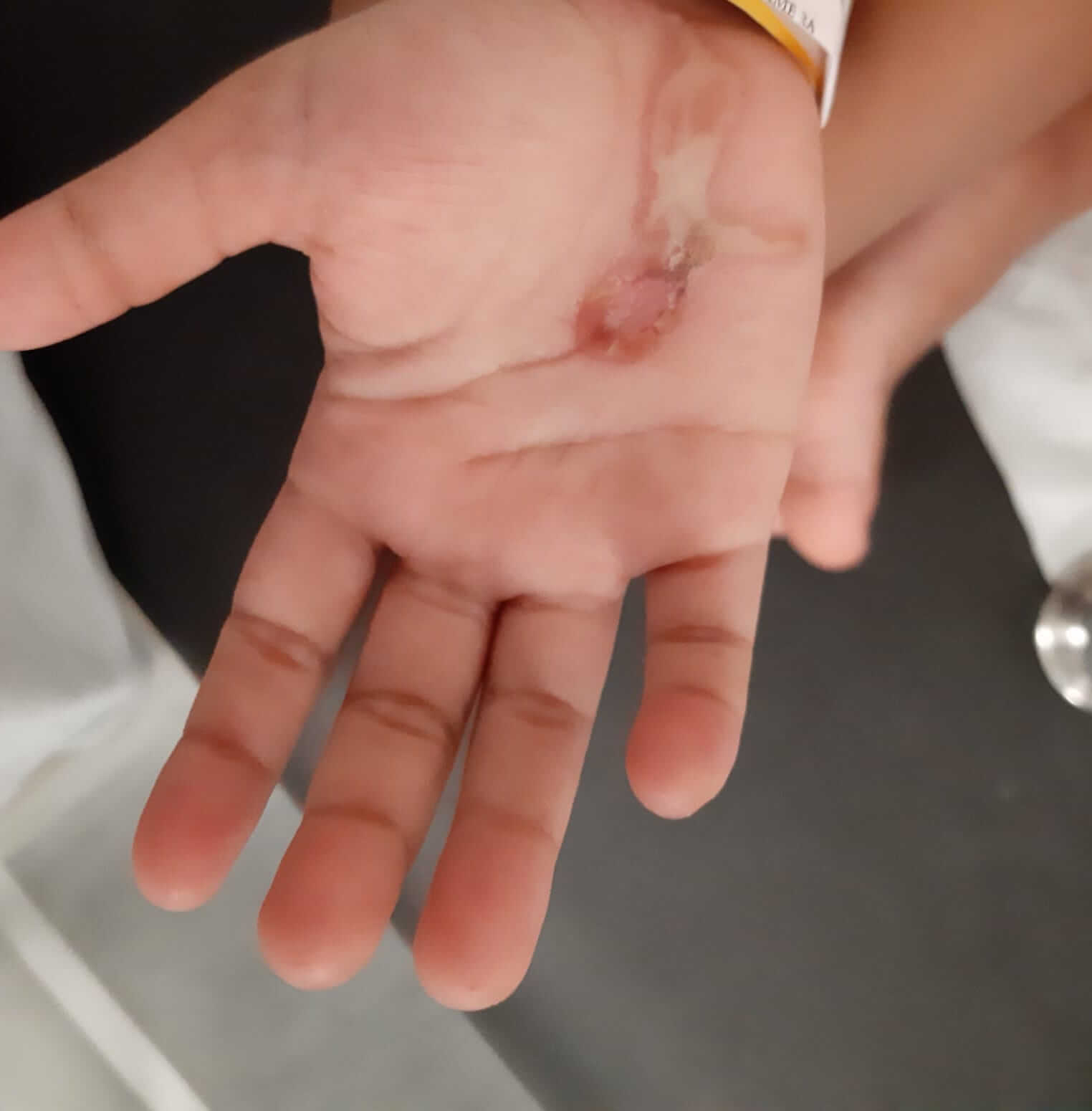 Figure 2.
 The second observation of the hand lesion (one week later). 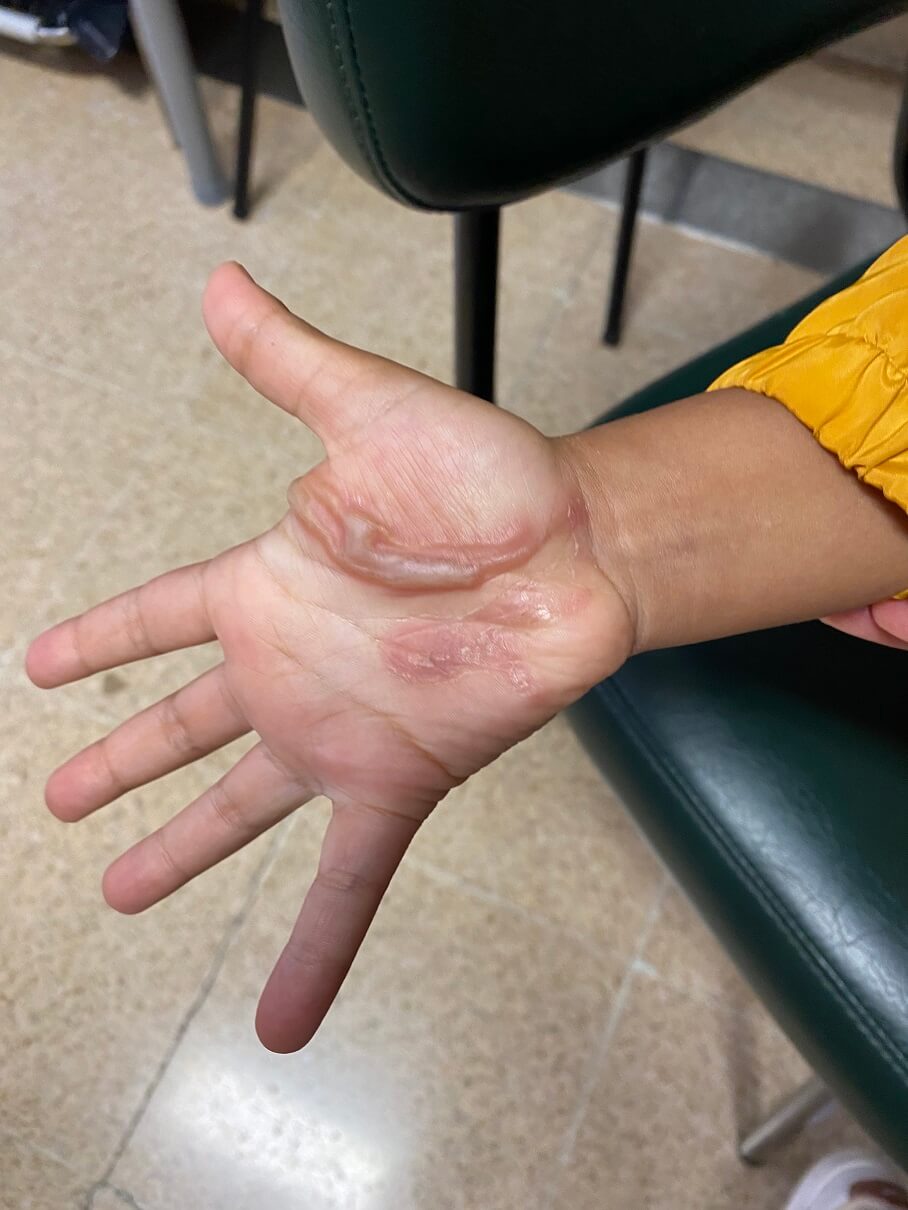 What is the diagnosis?
|
Discussion :
Based on these clinical findings, a diagnosis of cutaneous larva migrans was made. The girl completed a therapeutic cycle of three doses of albendazole and showed complete remission after 15 days (Figure 3). Additionally, a parasitological examination was carried out in the feces, in order to exclude other parasites.
Figure 3. Complete remission after three doses of albendazole. 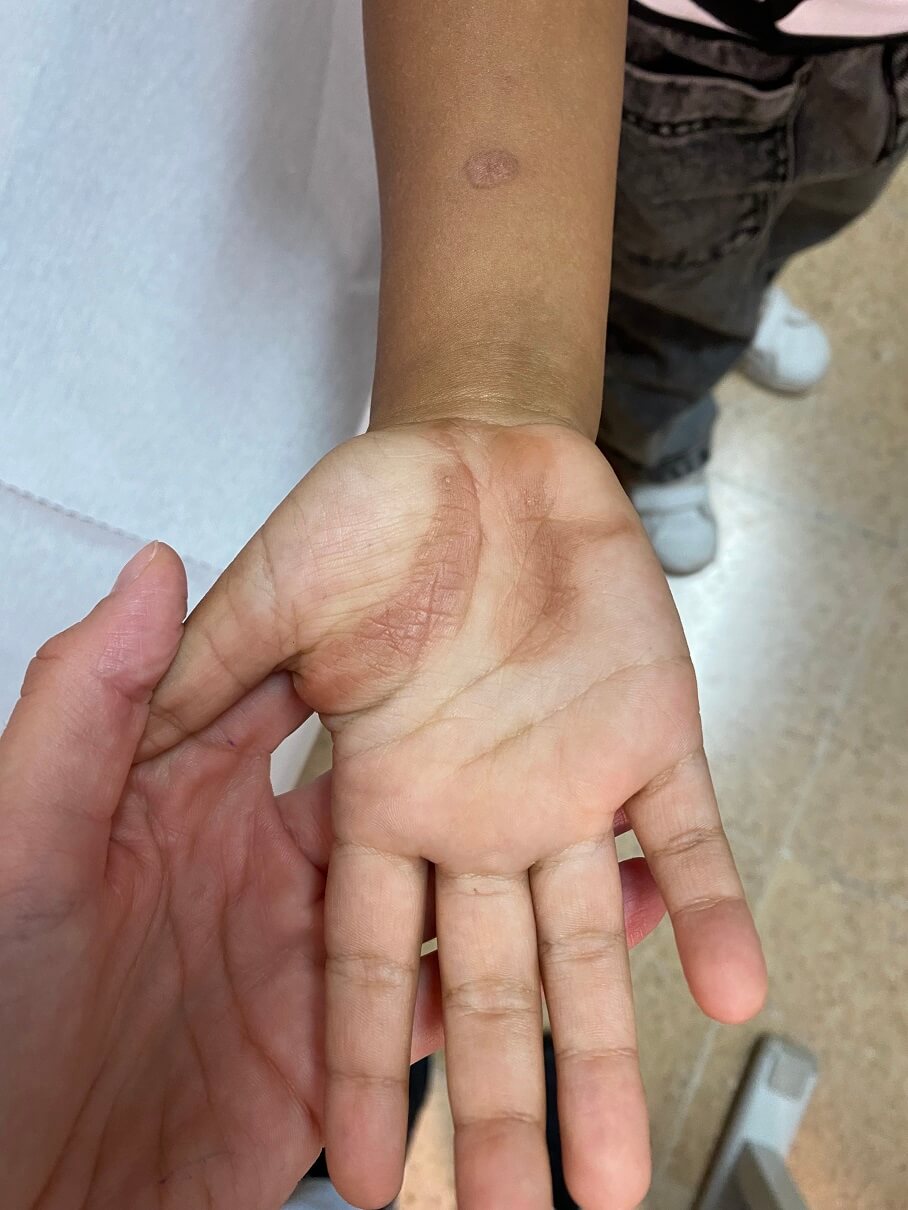
Cutaneous larva migrans is one of the most frequent helminth infections in travelers returning from tropical or subtropical countries after contact with infested soils. 1 The diagnosis is primarily clinical, based on the observation of a pruritic and migratory lesion on the skin. 2 Although the condition is usually self-limited, treatment helps to reduce the duration of symptoms. 3
This case highlights the importance of taking a comprehensive clinical history, including recent travel history and exposure to contaminated soils, as well as a close follow-up. | References : | - Leung AKC, Barankin B, Hon KLE. Cutaneous Larva Migrans. Recent Pat Inflamm Allergy Drug Discov. 2017;11(1):2-11.
- Prashanth SN, Kumar KJ, Kumar MGA. Cutaneous larva migrans in a child. Sudanese Journal of Paediatrics. 2017;17(1):66-67
- Villagrasa-Boli P, Martínez-Cisneros S, Monte-Serrano J. Larva cutánea migrans en viajero. Atencion Primaria. 2022 Jul; 54(7):102287. Spanish.
|
|
| Correct Answers : |  100% 100% |
Last Shown : Jul 2026
|