Beatriz Henriques1, Joana Victor Lage1, Maria Lurdes Torre1, Piedade Sande Lemos2
1Pediatrics Department, Hospital Professor Doutor Fernando Fonseca, Lisbon, Portugal, 2Hospitais CUF Cascais e Tejo, Lisboa, Portugal
Address for Correspondence: Beatriz Henriques, Rua José Cipriano Silveira Machado nº9 3ºG; 2745-140 Queluz, Lisboa, Portugal.
Email: beatrizfer.henriques@gmail.com
|
Question :We present a 16-year-old male diagnosed with Crohn’s disease at the age of 9. Upon diagnosis, he exhibited severe and extensive disease, including fistulizing perianal disease (Paris Classification A1L3B3) and a Pediatric Crohn's Disease Activity Index (PCDAI) >30. He was treated with Azathioprine (2-2,5 mg/kg/day) and Infliximab (5 mg/Kg at weeks 0 and 3 and then with maintenance infusions given every 6-8 weeks), with significant improvement of bowel disease.
During the first four years of treatment, he experienced intermittent, self-limited erythematous, scaly plaques scattered over the body, which responded well to symptomatic treatment with emollients and topical corticosteroids.
Five years after diagnosis, due to worsening of the bowel disease, the Infliximab therapy was increased to 10 mg/kg every 6 weeks and the patient experienced an exacerbation of the cutaneous lesions, which became widespread, particularly concentrated around the skinfold areas and scalp, causing intense pruritus. The patient denied the introduction of any new medications or topical products prior to the onset of the dermatosis (Figures 1 and 2).
Figure 1. Erythematous and scaly papules/plaques in the inguinal axillary area. 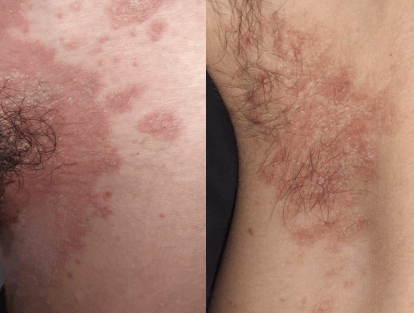 Figure 2.
 Erythematous and scaly papules/plaques in the suprapubic area. 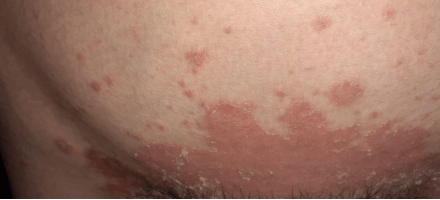
The patient reported worsening of these lesions after each Infliximab administration and due to the lack of improvement with symptomatic treatment, he was referred to a dermatology consultation. The biologic therapy was then switched to Ustekinumab leading to immediate improvement and complete resolution of the lesions six months after the therapeutic change. What is the diagnosis?
|
Discussion :
We report a case of infliximab-induced psoriasis.
Tumor necrosis factor (TNF) inhibitors, such as Infliximab, are commonly used in the treatment of chronic inflammatory diseases, including inflammatory bowel disease, rheumatoid arthritis and psoriasis. 1,2 In cases of moderate-to-severe Crohn's disease and/or fistulizing perianal disease, TNF inhibitors are the first-line treatment for induction and maintenance therapy. 3 However, various adverse cutaneous reactions associated with their use have been reported, with approximately 2-5% of patients treated with TNF inhibitors developing psoriasiform eruptions, known as paradoxical psoriasis. 4,5 This reaction may appear years after the initiation of treatment and its management can be challenging. 2,4 In refractory and severe cases, such as the one described, alternative therapeutic options should be considered.
In our case the switch from Infliximab – the offending drug - to Ustekinumab proved to be a key decision. Ustekinumab, a monoclonal antibody targeting interleukin (IL)-12 and IL-23, offers an alternative mechanism of action that may effectively manage both Crohn’s disease and psoriatic symptoms. 6,7 Although the literature has shown that a change to a different anti-TNF may ameliorate the psoriatic lesions 2,6,7, given the exuberance of the lesions and its impact in the patient´s quality of life, we opted to switch to a different biologic category.
This case illustrates the necessity of recognizing potential dermatologic complications arising from treatment in patients with IBD. Clinicians should remain vigilant and adopt a proactive approach in monitoring adverse effects such as skin manifestations, as timely intervention and adjustment of therapeutic strategies can lead to favourable outcomes. Further studies are warranted to better understand the mechanisms underlying Infliximab-induced psoriasis and to refine management protocols for affected patients. | References : | - Joyau C, Veyrac G, Dixneuf V, Jolliet P. Anti-tumour necrosis factor alpha therapy and increased risk of de novo psoriasis: is it really a paradoxical side effect? Clin Exp Rheumatol. 2012 Sep-Oct;30(5):700-6. Epub 2012 Oct 17. PMID: 22935567.
- Collamer AN, Battafarano DF. Psoriatic skin lesions induced by tumor necrosis factor antagonist therapy: clinical features and possible immunopathogenesis. Semin Arthritis Rheum. 2010 Dec;40(3):233-40. doi: 10.1016/j.semarthrit.2010.04.003. Epub 2010 Jun 26. PMID: 20580412.
- George LA, Gadani A, Cross RK, Jambaulikar G, Ghazi LJ. Psoriasiform Skin Lesions Are Caused by Anti-TNF Agents Used for the Treatment of Inflammatory Bowel Disease. Dig Dis Sci. 2015 Nov;60(11):3424-30. doi: 10.1007/s10620-015-3763-0. Epub 2015 Jun 27. PMID: 26115749.
- Lian N, Zhang L, Chen M. Tumor necrosis factors-α inhibition-induced paradoxical psoriasis: A case series and literature review. Dermatol Ther. 2020 Nov;33(6):e14225. doi: 10.1111/dth.14225. Epub 2020 Sep 15. PMID: 32844554.
- Chokshi A, Demory Beckler M, Laloo A, Kesselman MM. Paradoxical Tumor Necrosis Factor-Alpha (TNF-α) Inhibitor-Induced Psoriasis: A Systematic Review of Pathogenesis, Clinical Presentation, and Treatment. Cureus. 2023 Aug 1;15(8):e42791. doi: 10.7759/cureus.42791. PMID: 37664349; PMCID: PMC10469896.
- Matsumoto S, Mashima H. Efficacy of ustekinumab against infliximab-induced psoriasis and arthritis associated with Crohn's disease. Biologics. 2018 Jul 19;12:69-73. doi: 10.2147/BTT.S169326. PMID: 30050284; PMCID: PMC6055910.
- Andrisani G, Marzo M, Celleno L, Guidi L, Papa A, Gasbarrini A, Armuzzi A. Development of psoriasis scalp with alopecia during treatment of Crohn's disease with infliximab and rapid response to both diseases to ustekinumab. Eur Rev Med Pharmacol Sci. 2013 Oct;17(20):2831-6. PMID: 24174369.
|
|
| Correct Answers : |  100% 100% |
Last Shown : Aug 2026
|