Patient Education
Why Breast Feed?
Breast milk is the best food for babies as it meets all the requirements. It comes with the right nutrients, ready any time the baby wants at the right temperature with no need for sterilization of equipment or preparation. It is the precious gift any mother can give it to their babies. There is enough evidence to suggest Breast milk offers short term and long term benefits both in the developing and developed world.
What are the Benefits of Breastfeeding?
- Breast milk provides all the nutrients that a baby needs for the first six months of life to grow and develop.
- Breast milk continues to provide high-quality nutrients and helps protect against infection up to two years of age or more.
- Breast milk protects babies from infections and illnesses.
- Babies find breast milk easy to digest.
- The baby's body uses breast milk efficiently.
- Breastfeeding can contribute to birth spacing.
- Breastfeeding helps the mother's uterus to contract reducing the risk of bleeding after birth.
- Breastfeeding lowers the rate of breast and ovarian cancer in the mother.
- Breastfeeding promotes a faster return to mother's pre-pregnancy weight.
Breast milk contains all the nutrients which are required for normal growth and development. All babies can easily digest and absorb Breast milk. There is enough evidence to suggest it decreases the risk of necrotizing enterocolitis(NEC) in Preterm babies. Breastfed babies have lower rates of diarrhea, respiratory tract illness, acute and recurrent otitis media, and urinary tract infection. Breastmilk also protects babies against allergic diseases and reduces sudden infant death syndrome (SIDS).
Breastfed babies have a lower risk of obesity, cancer, coronary heart disease, inflammatory bowel disease, and Diabetes mellitus. Breastfed babies have lower chances of malocclusion. Breastfed babies have better cognition, Intelligence quotient(IQ) and visual function as Breastmilk is rich in docosahexaenoic acid (DHA). Breastfed babies have a lower risk of behavior problems later in life.
Breastfeeding improves bonding, helps in uterine involution, reduces postpartum hemorrhage. It also protects against pregnancy, breast cancer, and ovarian cancer. It also helps the mother to lose weight. Breastfeeding is convenient, time-saving and economical to mothers.
What is the composition of Breastmilk?
The Breastmilk is a complex fluid that comprises many chemical and cellular components.
Breast milk is 70% whey and 30% casein. The predominant whey proteins are alpha-lactalbumin, lactoferrin, lysozyme, and IgA.
Lactose and oligosaccharides are the main carbohydrates present in breastmilk.
Breast milk fat is rich in polyunsaturated fatty acids and is the major energy source. The hindmilk fat is 1.5 to 3 times more than foremilk fat. DHA (docosahexaenoic acid) is of the omega-3 type of Long-chain polyunsaturated fatty acid(LCPUFA) which has anti-inflammatory properties and present in the brain and retina thereby helps in neurodevelopment and visual acuity. Breast milk also contains Vitamins, minerals, growth factors, enzymes and hormones
Colostrum: It is secreted during 3-4 days after delivery. It is produced small in quantity, 15-20 ml during day 1, yellow and thick and it is rich in antibodies, macrophages, and Vitamins.
Transitional milk: Milk secreted after 3-4 days until 2 weeks.
Mature Milk: It follows transitional milk.
Foremilk: secreted at the beginning of breastfeeding and is rich in proteins, sugar, vitamins, minerals, and water that relieves the baby’s thirst.
Hindmilk: secreted during the later part of breastfeeding and is rich in fat which provides energy and gives a sense of satiety.
What are the common recommendations on Breastfeeding?
All hospitals should have a written policy on Ten Steps to Successful Breastfeeding developed by WHO and UNICEF as criteria for a Baby-Friendly Hospital.
All mothers should be prepared and counseled during the antenatal period regarding the benefits of breastfeeding and how to initiate and manage to breastfeed.
Help all mothers to breastfeed within one hour after birth.
Encourage breastfeeding on demand
Exclusive breastfeeding for 6 months
Long term benefits depend on the duration of Breastfeeding.
How to manage and support successful Breastfeeding?
Figure : Breast Feeding
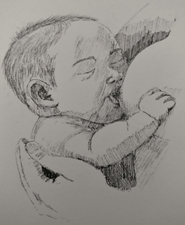
Mothers should be shown in different breastfeeding positions and how to hold a baby during breastfeeding. Mothers should be taught how to recognize Good Latching and poor Latching. Effective milk transfer requires good coordination of suckling and swallowing.
Minimum Breastfeeding frequency is at least eight times in 24 hours. The mother should try to demand feed and taught to recognize signs of hunger and satiety and cues for readiness to Breastfeeding. The mother should offer both breasts at each feeding and make sure the breast is completely emptied so that baby can get the benefits of both Foremilk and Hindmilk.
How to Express Breast Milk?
Sometimes mothers need to express their milk when the baby is not ready and unwell and breastfeeding is not completely established. Mother can either express the milk by hand or using a breast pump (Manual or electrical). The mother needs to be demonstrated the different steps involved and how to use a breast pump.
The expressed milk can be stored at room temperature for 4 hours, in a fridge for 24 hours, and a freezer at -2°C for 3 to 6 months.
What are the common problems of Breastfeeding?
Breastfeeding problems are commonly seen in clinical practice and most of the problems can be easily prevented by simple advice. Mother can have a sore nipple, inverted nipple, and a flat nipple. The sore nipple is more common when latching is not adequate. If the breast is not emptied fully then the mother can have breast engorgement and breast abscess. Candida infection of the nipple and oral thrush in babies are commonly seen in clinical practice. Early recognition and referral to a lactation consultant is very important in managing breastfeeding problems.
Positioning and attachment for breastfeeding?
To help a mother learn how to breastfeed first encourage her to get herself into a comfortable position. Show her how to hold the baby straight, with both the baby's head and body turned to face her breast and with the baby's nose opposite her nipple. She should hold the baby close supporting the whole body, not just the neck and shoulders. Refer to breastfeeding aids and materials to help you become more familiar with correct positioning and attachment.
Correct breastfeeding positioning occurs when the baby's:
- head and whole body are well supported and held close to mother
- face and stomach face the mother
- ear and shoulder are in one straight line, neck is not twisted
Good attachment occurs when the baby's:
- Mouth covers most of areola (dark part of the nipple) with some of the areola visible above the mouth
- Mouth is wide open
- Chin touches the breast
- Lower lip is turned outwards.
Effective suckling occurs when:
- Slow, deep firm sucks alternate with bursts of suckling
- No other sounds except swallowing sounds are heard
Exclusive breastfeeding
All mothers should be encouraged to exclusively breastfeed their babies until they are six months old. Exclusive breastfeeding means that the baby is not given any other food or drink, not even water. They are only given breast milk. Make sure that you or others in the facility do not give the baby anything that will interfere with exclusive breastfeeding.
REMINDER
To encourage and support exclusive breastfeeding there are key things you can do:
- Encourage breastfeeding frequently, day and night, and advise the mother to allow the baby to feed for as long as he/she wants. Tell her it is quite normal for a baby to feed up to eight times a day. Explain to her the signs a baby will show when he/she needs to be fed (such as “rooting”, looking for the nipple, sucking on the hand).
- Reassure the parents that there is no need to give the baby any other drink or food, not even water – breast milk has all a baby needs.
- Help the mother whenever she needs assistance and especially if she is a first time or adolescent mother or a mother with other special needs.
- Explain to the mother she should let the baby finish the first breast and come off on its own before offering the second breast.
- Encourage the mother to start each feed with a different breast. For example, if the left breast is used to start one feed, at the next feeding start with the right breast.
- If it is necessary to express breast milk, show the mother how to do this and show her how to feed expressed breast milk by cup. You may need to refer her to a trained infant feeding counsellor for this.
- Reassure the mother that her body will make enough breast milk to satisfy her baby's needs. Just because a baby is crying, it does not mean that she does not have enough breast milk. A baby who is demanding more breast feeds may be growing. By allowing the baby to suckle more often, her body will produce more breast milk to meet her baby's needs.
- Explain that the mother can provide all the breast milk her baby needs for the first 6 months and beyond.
- Explain that the mother can continue breastfeeding if she has to return to work or school, either by expressing breast milk or feeding more often when she is at home.
- Advise her to seek help (or come back to see you) if the baby is not feeding well or if she has any difficulties or concerns with breastfeeding, sore nipples or painful breasts. If needed, refer her to a trained infant feeding counsellor.